The Pink Tarha
Showing posts with label Tourism Malaysia. Show all posts

Tuesday, December 18, 2012

Shopping in Kuala Lumpur {1/2}

Hello everyone! Our entries have dwindled since the start of December because we are currently on vacation. Eyecandy and I are in the Philippines for the holidays while Shoegarfreeruby and Sampaguita Pride are very busy with work and their families. You have to forgive us for the lack of posts until the first week of January. However, we'll sneak in once in a while to publish articles because hey, The Pink Tarha thrives on! ;)

For now, we're publishing entries from Tourism Malaysia. We all know how popular Malaysia is as a tourist destination for Saudis. As for Southeast Asians like us, Malaysia is also very accessible from our home country so it is one of the first countries we visit when we want to go out of the Philippines for shopping and leisure (something new!). So, here's more of the shopping-scape in Malaysia... (Travel + Shopping = Happy Pink Tarha ladies!)

Shopping in Kuala Lumpur can be very rewarding. You’ll find a mall, market, or night market (pasar malam) in practically every corner of the Malaysian capital, almost all of them accessible by monorail or LRT. The KL shopping scene is such a big draw, the government sponsors a three-month sale season from June to September. In this article, we’ll show you what you can buy in Kuala Lumpur, and where you can find what you’re looking for. 

What To Buy

Kuala Lumpur is the crossroads for practically everything made in Malaysia – pottery, wood carvings, food products, and traditional fabrics from far-flung Malaysian states can all be found here. Closer to the city, the adjoining state of Selangor is also known for its high-quality pewter craft, which can be purchased at almost any market stall, or right at the factory itself. 

If you’re in the market for unique Malaysian fabrics, look for shops that sell kain songket: silk or cotton woven cloth brocaded with gold or silver threads. The metallic threads create a shimmering pattern against the non-reflective fabric, and the patterns created by the master weavers are very Malaysian in character. Normal people wear songket fabric only on special occasions; rich garments made from songket are more frequently worn by Malaysian royalty. 

Kain songket fabric and clothes come in many textures, colors, and styles; simple designs are cheap and readily found almost anywhere, but more intricate songket weaves may cost thousands of Malaysian ringgit per yard, reflecting the effort and thought that goes into their manufacture. To buy kain songket, go to Wisma Yakin in KL’s Masjid India. Wisma Yakin is known for its many tailors and fabric shops; Malay mothers typically go to Wisma Yakin to get clothes made for Eid ul-Fitr. 

The Malaysian state of Selangor has long been known for its fine pewter craft; pewter is a tin-based metal that finds common usage in drinking implements, tableware, and desk accessories. Selangor long prospered due to its tin mining industry, in fact Kuala Lumpur started out as a trading post serving tin miners. 

Today, the finest quality pewter is produced by Royal Selangor, Malaysia’s foremost pewterware maker. Royal Selangor creates pewterware fine enough for the Sultan of Selangor’s use, thus the “Royal” in the name. While their work can be found in most shopping malls around Kuala Lumpur, you can best explore the history and craft of pewterware at the Royal Selangor Visitor Centre in Setapak Jaya, around 8 km northeast of the city center. Closer to the city, you can visit Royal Selangor’s main outlet at level one of Suria KLCC

Kuala Lumpur’s Shopping Malls 

Of course, there’s far more to Kuala Lumpur than just pewter picture frames and beautiful fabrics. The many shopping malls in the city are filled to bursting with electronics, modern designer clothing, books, and perfumes. 

The Golden Triangle is ground zero for KL’s shopping scene: this is where you go to buy a wide range of merchandise from one of the many malls in the area. Suria KLCC, at the feet of the iconic Petronas Twin Towers, is perhaps Kuala Lumpur’s most popular shopping stop, with trendy clothes, footwear, and accessories stores sharing space with the entrance to the Twin Towers tours. 

Bukit Bintang Plaza, one of the first shopping centers in the city, is still going strong with shops selling fashion accessories, sporting goods, footwear, and clothes. For electronics, visit Low Yat Plaza to get the lowest prices possible on laptops, tablets, and other electronic devices. The world’s finest shops – Dior, Kenzo, Valentino and more – can be found at Starhill Gallery next to the Marriott. Also not to be missed is the Times Square mall. 

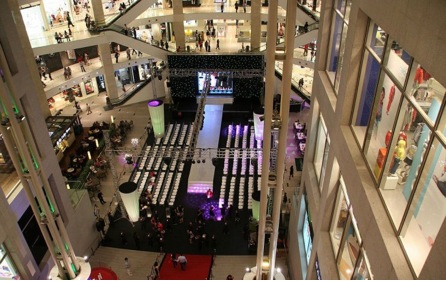
Times Square Mall in Kuala Lumpur (Photo by Shane Dallas)
For a more traditional Malay shopping experience, go to Jalan Tuanku Abdul Rahman, whose many buildings dating back from before World War II represent some of Kuala Lumpur’s best-preserved historical structures. Among these buildings, you’ll find a wide array of shopping centers like the Sogo Department Store and Pertama Complex

Kuala Lumpur’s most famous night market occurs along this stretch – every Saturday evening, Lorong Tuanku Abdul Rahman is closed to traffic and becomes crowded with stalls and hawkers selling all sorts of goods, from local products to cheap tourist souvenirs to excellent halal street food. Near Jalan Tuanku Abdul Rahman, Jalan Masjid India – the city’s Indian enclave – sells Indian merchandise like bangles, silverware, gold jewelry, and saris. 

Indian bangles (Photo by Joan Lane)
Finally, Chinatown is your best place for cheap bazaar-style shopping. The iconic Petaling Street stretch, covered by a green awning, is lined with shops and hawkers selling all sorts of affordable goods, from fake branded items to delicious local cuisine. Bargaining is highly encouraged for shoppers visiting Petaling Street, if you want to get the best value out of your purchases in this area. Chinatown’s Pasar Seni, or Central Market, is a former wet market and currently a bazaar selling Malaysian products like kain songket, batik, and handicrafts.

It's refreshing to know how the shopping-scape in other countries are like. We can't wait to travel more and shop more! ;) ~ Sundrenched

Tuesday, November 27, 2012

Best Artisanal Buys {A Feature on Malaysia 3/4}

Welcome back to our feature on the shopping scene in Malaysia

Most travelers are into buying souvenirs... especially us Filipinos! It's one of the first few things that we look for when visiting a new place. In Malaysia, it'll be nice to know what signature arts and crafts are available. They're the perfect gifts for family and friends back in your home country. 

Given the diversity of ethnic groups in Malaysia, these vary from place to place. Because of this, many resort to going to Kuala Lumpur’s Central Market at the end of their trip to fill their suitcase with items from all around Malaysia. However, you should always be on the lookout whenever you're out and about the places in Malaysia. One huge tip is to find artisans and buy directly from them so you’ll get better prices and you're assured that your money goes to the creators directly. 

Craft stalls in markets like Kuching, Sarawak are good places to pick up locally made products.
Photo by Joanne Lane.
 Here are five main crafts to look out for during your travels:

Batik and other fabrics 
Yes this is inherently an Indonesian craft, but batik is also prevalent around Malaysia and somewhat different in style to its neighbor's. Batik is basically created by drawing or printing a pattern on fabric with wax. It is then dyed. This design is often reproduced on anything from clothing to tablecloths or cushion covers, but you can equally find it simply as wall hangings or art works. 

The best places to find batik crafts are on Malaysia’s eastern coast in Pahang, Kelantan and Terengganu but you can also find it in Penang. In Malaysia most of the batik designs are floral motifs and quite colourful and the patterns tend to be simpler. 

The Malaysian government is actively promoting the development of batik patterns and promoting it as a national dress. There’s also a biennial convention, Kuala Lumpur International Batik (KLIB) Convention and Exhibition, that brings in anything related to batik. The last event was held in December 2011. 

Another kind of fabric to keep an eye out for is kain songket. This textile with hand woven silver and gold threads was once reserved for members of royalty only. Now anyone can wear it but it’s usually only used for special occasions. Kelantan, Terengganu and Khota Bharu are where you’ll still find small cottage industries making this product. A songket factory is located at Kampung Penambang north of Khota Bharu. Try the Buluh Kubu Bazaar, also known as Bamboo Fort Bazaar, for a variety of other textile products in Khota Bharu. 

Malaysia is renowned for its many fabrics and woven materials. Photo by Joanne Lane. 
Metalwork 
If silverwork is your metal of choice you may want to look out for the silversmiths of Kelantan where their work is generally considered intricate and of superior quality. They use two techniques here – filigree and repousse – and you’ll find everything from tea sets to brooches and bracelets. Visit the silvercraft factory at Kampung Sireh, Kota Bharu

If brasswork is more what interests there are ample industries producing various work in Kuala Terengganu. Silverwork, textiles, woodcraft and kites are also produced here, particularly in the waterfront district of Kampung Cina

Woven products 
Various weaving methods are used around Malaysia to produce an array of gift boxes, mats, bags, hats, shoes, fans and more. You’ll see many of these practiced as a cottage industry all around the country. 

Pua kumbu weaving is common in Malaysian Borneo amongst Iban people for producing ceremonial items for use in birth, marriage, funeral and other rituals. For example a child may be cleaned when first delivered and then laid on apua kumbu, or a corpse may be screened with such a cloth. Pua kumbu are also used to veil structures. To produce the pua kumbu a special dyeing process called ikat is used by which the designs are dyed onto the threads before they are woven. 

Mengkuang is the practice of weaving the strands of the pandanus tree that grows in mangrove forests and jungles. The leaves are stripped, split into strands, soaked, dried, boiled and dyed with vegetable colours. The colourful woven fragments are then used to make various products. This practice still thrives in the eastern states of Peninsular Malaysia. 

Woodcarving 
The Kenyah and Kayan peoples of Malaysian Borneo are generally considered very skilled carvers. In places like Semporna you’ll also find designs of lepa boats, a traditional wooden-hulled single-mast boat. 

A carved lepa boat in Semporna, Sabah. Photo by Joanne Lane. 
Woven baskets 
Woven baskets are commonly found in Malaysian Borneo and produced by a variety of ethnic groups including the Iban, Kayan, Kenya and Penan. Here you’ll find baskets, mats, seats and other materials made from rattan, bamboo, swamp grass and pandanus. These are commonly sold in markets around Borneo such as in Kuching but you’ll also find them in longhouses where they maybe available for purchase.

Now that you know what to look for when it comes to souvenirs in Malaysia, it won't be difficult to shop your way around.

Saturday, November 10, 2012

Kuala Lumpur: A Shopper's Paradise

Good morning, Pink Tarha readers! We've been away from the blog for the first week of November because of the recently concluded second workshop of the Pink Tarha Mornings. It was very, very successful and we'll tell you about it in another entry. For now, we're 'traveling' to one of the favorite destinations in Asia... Malaysia!

It was in 2007 when I first went to Malaysia as a representative of my workplace in the Philippines (that was before Saudi Arabia happened in my life) in a press junket. It was one of the most memorable trips ever because it was my first time to travel outside the Philippines... and alone at that! It was such an amazing experience and I urge everyone to go and travel to Kuala Lumpur, Malaysia's capital, where the shopping action is happening! So, let's go!

Kuala Lumpur: A shopper’s paradise 

A shopping trip to Kuala Lumpur is a holiday in itself. It presents visitors with some of the best and biggest malls that the region offers, and the best value for money too. Shoppers can shop within the multi-story shopping complexes or at sidewalk stalls, bazaars, and night markets (pasar malam). You should keep in mind that the city is just teeming with shopping opportunities. 

Bukit Bintang 

One of the great shopping destinations in KL is Bukit Bintang/Bintang Walk. The Bintang Walk, located in the heart of Kuala Lumpur, is one of the most famous shopping centers in Malaysia. At night, you will be spellbound to see the colorful and dazzling array of lights in this area. It’s a perfect place for people watching over a latte between bouts of bargain hunting. 

Bukit Bintang has the highest concentration of malls in Kuala Lumpur. Low Yat Plaza is the place to go if you need any piece of technology. The entire plaza is made up of technology retail outlets and stalls with MP3 players, DVD cameras, computers and etc. Every electrical items and optical product you might ever want can be bought from Sungei Wang. Starhill Gallery specializes in luxury and designer brands such as watches, jewellery, fashion and leather good. In Pavilion KL, you can find designer brands, cosmetics and fashion goods. 

Centre Court at the Pavilion shopping mall 
All the stores are open by 11am and shut around 10pm. The easiest way to get there is by taking the Kuala Lumpur Monorail and stop at Bukit Bintang Station or by hiring a taxi where a good drop off point would be Star Hill Plaza, then you could walk all the way down the street to Low Yat Plaza. 

Ain Arabia 

Ain Arabia or Arab Street is located just a few minutes’ walk from Bukit Bintang. Ain Arabia was designed to recreate the shopping lifestyle of the Middle East, so that Arabs could come to dine, shop and meet. There’s also an Arab barber to cut hair the way Arab men like it; the Hay-al Arab Restaurant, which serves Yemeni cuisine, Naab’s mini market selling Lebanese bread and even dates, and the Al-Khaima souvenir shop stocks perfume oils and incense wood chips and other stuff. 

If you come using the monorail, stop at Bukit Bintang monorail station from where the street is just five minutes walk away. There is an arch with the name “AIN ARABIA” engraved on it as you walk along the street. 

Chinatown 

Your shopping experience in KL will not be complete without a trip to Chinatown. It’s full of stalls and boutiques lining up side by side. It is also known for its jewelry shops with their fascinating variety, in addition to Chinese pharmacies, which sell ginseng and all sort of traditional remedies. Moreover, you can enjoy plenty of delicious Chinese food. You will need to bargain hard for the best prices. 

The night time action in Chinatown
You can walk to Chinatown / Petaling Street from Maharajelela station, or take the Monorail to Maharajalela or MRT to Pasar Seni or Masjd Jamek; then follow the signs to Petaling Street. 

Little India 

If you are seeking an interesting shopping experience then the Little India area is well worth a stroll. All along these streets you will find shops selling everything Indian – from gorgeous silk, cotton and brocade sari materials to stainless steel tiffin carriers. I bought shawls for the women of my family here and up to now, they're still using it. One of them, my grandmother's, is with me here in Saudi Arabia because even if it was my gift for her, she gave it to me to "keep me warm." I love the shawls and scarves from Little India!

Everywhere, you will find colorful shops selling saris, spices, and sandalwood, in addition to some delicious Indian food too. It has some lovely old shop houses, market stalls and the Masjid India, India Mosque, from which the area takes its name. 

To get to Little India from Masjid Jamek station you can take the LRT to either the Star LRT or Putra LRT stations. Little India is just a short walk from the stations. Other choices are buses and taxis, which are easily available. 

Those looking to grab art pieces by local artists can head to Central Market while Chow Kit Market and Kasturi Walk are filled with mini-stalls selling everything from sunglasses and second hand books to clothes and figurines. 

Shopping in KL is sheer fun and exciting as well. The exemption of duty on certain items has also resulted in more competitive pricing and made shopping in Malaysia a much more attractive option. Frankly, a trip to KL is not complete without some serious retail therapy. 

If you enjoyed this article and would like to find out more about travelling to Malaysia, please visit the Tourism Malaysia website.
Related Posts Plugin for WordPress, Blogger...